Mortgages To Fit Your Life Plan

Professional advice for working professionals

So you can live your best life with a strategy to achieve your real estate and financial goals

BOOK A MEETING
Feel Empowered

Get the advice, strategy, and mortgage to achieve your lifestyle goals.


Save Time and Money

Achieve long term savings beyond just rate.

Experience our personalized and technology driven process designed to be efficient and convenient for you.


req-estimate_100x100
Create Wealth

Take advantage of opportunities to enhance your financial future with real estate investing.

Getting a mortgage on your own with a traditional bank can COST you!

Frustration

with paying more overall costs for your mortgage beyond rate

Overwhelmed

with spending excessive time researching for options

Struggle

with making the right decision without a mortgage professional whose interest is aligned with you

Miss out

on options and expertise that the banks do not offer

We believe you deserve

You deserve a mortgage that works for you.  Finding and financing your home is a huge investment in time and money.  For most, it is the biggest financial investment they’d ever make in their lifetime.

Ther
efore, your mortgage should fit into your overall financial strategy.  Unfortunately, the mortgage industry isn’t set up that way.  Most banks and mortgage providers are very transactional, and rate focused.  We want to provide you with much more to ensure you are empowered in the process, get clarity on where you are going and be confident that your mortgage fits into your overall financial life plan.


Let us be your strategic mortgage partners

Matthew Chan
CPA, CA
Mortgage Consultant
MEET THE TEAM

Matt still remembers clearly when he bought his first home.  At the time, he was still raising a very young family and just started his new mortgage career.  The prospect of buying his first home was overwhelming and downright terrifying.


Matt also remembered the feeling when he bought his first investment property.  There was a lot of anxiety he had no idea what it meant to be a landlord, whether or not it was the right decision and time to buy and even if it was affordable.


Because of this experience and his love of real estate, Matt is dedicated to supporting others to achieve their dream of home ownership.  Whether you are buying your first home or aspire to build a real estate empire, Matt is committed to providing a sound strategy to achieve your goals.


After starting his career as a professional accountant and achieving his CPA (CA) designation in Vancouver, Matthew moved to Toronto to pursue an MBA from the Rotman School of Management at University of Toronto.  In 2004, Matthew moved back to Vancouver to raise his family and start his mortgage career.


Since starting his career, Matthew has served as a board member for the Canadian Mortgage Broker Association of BC and achieved Elite Hall of Fame status with Dominion Lending Centres. Matthew is also an avid Real Estate Investor and loves to share his knowledge and passion of real estate investing with others.


With his professional qualifications, educational background, industry experience as both a mortgage professional and as a real estate investor, Matthew has the skillset to advise you on your mortgage and real estate goals. 


When not in his office, Matthew enjoys spending time with family and friends, training Gracie Jiu Jitsu and pursuing personal and professional development.

Here are some nice things clients say about working with us

Let us help you find a mortgage that best fits your life plan   
Budget
Proposal

We review both the costs to complete and the regular recurring costs of home ownership with you so you feel secure and confident to move forward every step of the way.

Mortgage
Options

We listen to you and provide advice and financial education.  With access to multiple lenders and products, we can review and present options that fit with your plan.

Support You Throughout the Process

We keep you regularly updated from the start to completion.  Once you complete, we continue with regular updates to ensure we are still moving towards your goals.

We'll guide you to a solution with these 3 simple steps

Schedule A

Discovery Call

We get to know each other a bit better and learn more about what your short term and long term real estate and financial goals are. We get a high level view of what your options could look like. 

Build a Custom Mortgage Proposal and Review Strategy with You

After we review your application in more depth, we propose options and help you evaluate the pros and cons of each, You get more clarity on your strategy for your long term goals.


We Implement

The Plan

With more insight, you choose the option that best fits your life. We handle the rest. You feel confident and empowered knowing you made a great decision.

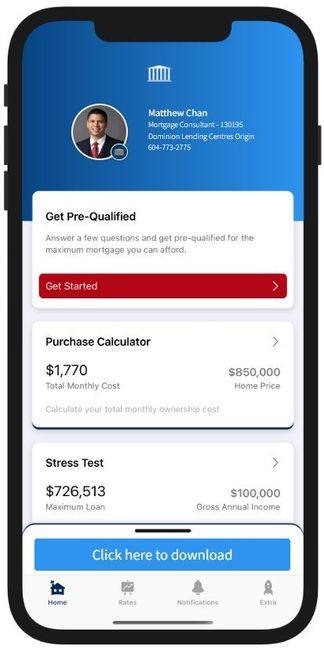
Download My Mortgage Toolbox using my personal install buttons below so you can get exclusive access to all premium features.

WHAT CAN YOU DO WITH MY APP:


  • Calculate your total cost of owning a home
  • Estimate the minimum down payment you need
  • Calculate Land transfer taxes and the available rebates
  • Calculate the maximum loan you can borrow
  • Stress test your mortgage
  • Estimate your Closing costs
  • Compare your options side by side
  • Search for the best mortgage rates
  • Email Summary reports (PDF)
  • Use my app in English, French, Spanish, Hindi and Chinese

 

ARTICLES

By Matthew Chan February 4, 2026
You’ve found the right home, your offer’s been accepted, and your financing is approved—congratulations! But before you can pick up the keys and celebrate, there’s one more important stage: the closing process. Closing is the final step in your homebuying journey, where all the paperwork, legal details, and financial transactions come together. It can feel overwhelming if you don’t know what to expect, but with the right preparation, closing can be smooth and stress-free. Here’s a step-by-step guide to help you understand the process. Step 1: Hire a Lawyer or Notary A real estate lawyer (or notary, depending on your province) handles the legal side of closing. They will: Review the purchase agreement and mortgage documents Conduct a title search to confirm the seller has the legal right to sell the property Ensure the mortgage lender is properly registered on the title Handle the transfer of funds between you, the lender, and the seller Your lawyer or notary will be your main point of contact during closing, so choose one you trust and who communicates clearly. Step 2: Finalize Your Mortgage Your lender will send the mortgage instructions directly to your lawyer or notary. At this stage: You’ll provide proof of property insurance (lenders require this before releasing funds) You’ll confirm your down payment and closing costs are available in your lawyer’s trust account The lawyer will prepare all documents for your review and signature Step 3: Pay Closing Costs Closing costs typically range from 1.5% to 4% of the purchase price. These can include: Legal fees Title insurance Land transfer tax (where applicable) Adjustments for property taxes or utilities prepaid by the seller Home inspection or appraisal fees (if not already paid) Your lawyer will provide a final statement of adjustments so you know exactly how much is due on closing day. Step 4: Sign the Paperwork A few days before closing, you’ll meet with your lawyer or notary to sign all the necessary documents, including: Mortgage agreement Title transfer Insurance confirmations Statement of adjustments Bring valid government-issued ID to this appointment. Step 5: Transfer of Funds On the day of closing: Your lender sends the mortgage funds to your lawyer Your lawyer combines these funds with your down payment and pays the seller Legal ownership of the property is transferred into your name The lender is registered on title as a secured creditor Step 6: Get the Keys! Once the paperwork is filed and the funds have cleared, your lawyer will confirm that the transaction is complete. You’ll then get the keys to your new home—officially making it yours. The Bottom Line The closing process is a series of important steps, but with the right team in place, it doesn’t have to be stressful. By working closely with your mortgage professional and lawyer, you’ll have guidance every step of the way—from signing the documents to turning the key in the front door. If you’d like help preparing for the closing process—or want a clear breakdown of your own closing costs— connect with us today.
By Matthew Chan January 28, 2026
Bank of Canada maintains policy rate at 2¼%. FOR IMMEDIATE RELEASE Media Relations Ottawa, Ontario January 28, 2026 The Bank of Canada today held its target for the overnight rate at 2.25%, with the Bank Rate at 2.5% and the deposit rate at 2.20%. The outlook for the global and Canadian economies is little changed relative to the projection in the October Monetary Policy Report (MPR). However, the outlook is vulnerable to unpredictable US trade policies and geopolitical risks. Economic growth in the United States continues to outpace expectations and is projected to remain solid, driven by AI-related investment and consumer spending. Tariffs are pushing up US inflation, although their effect is expected to fade gradually later this year. In the euro area, growth has been supported by activity in service sectors and will get additional support from fiscal policy. China’s GDP growth is expected to slow gradually, as weakening domestic demand offsets strength in exports. Overall, the Bank expects global growth to average about 3% over the projection horizon. Global financial conditions have remained accommodative overall. Recent weakness in the US dollar has pushed the Canadian dollar above 72 cents, roughly where it had been since the October MPR. Oil prices have been fluctuating in response to geopolitical events and, going forward, are assumed to be slightly below the levels in the October report. US trade restrictions and uncertainty continue to disrupt growth in Canada. After a strong third quarter, GDP growth in the fourth quarter likely stalled. Exports continue to be buffeted by US tariffs, while domestic demand appears to be picking up. Employment has risen in recent months. Still, the unemployment rate remains elevated at 6.8% and relatively few businesses say they plan to hire more workers. Economic growth is projected to be modest in the near term as population growth slows and Canada adjusts to US protectionism. In the projection, consumer spending holds up and business investment strengthens gradually, with fiscal policy providing some support. The Bank projects growth of 1.1% in 2026 and 1.5% in 2027, broadly in line with the October projection. A key source of uncertainty is the upcoming review of the Canada-US-Mexico Agreement. CPI inflation picked up in December to 2.4%, boosted by base-year effects linked to last winter’s GST/HST holiday. Excluding the effect of changes in taxes, inflation has been slowing since September. The Bank’s preferred measures of core inflation have eased from 3% in October to around 2½% in December. Inflation was 2.1% in 2025 and the Bank expects inflation to stay close to the 2% target over the projection period, with trade-related cost pressures offset by excess supply. Monetary policy is focused on keeping inflation close to the 2% target while helping the economy through this period of structural adjustment. Governing Council judges the current policy rate remains appropriate, conditional on the economy evolving broadly in line with the outlook we published today. However, uncertainty is heightened and we are monitoring risks closely. If the outlook changes, we are prepared to respond. The Bank is committed to ensuring that Canadians continue to have confidence in price stability through this period of global upheaval. Information note The next scheduled date for announcing the overnight rate target is March 18, 2026. The Bank’s next MPR will be released on April 29, 2026. Read the January 28th, 2026 Monetary Report
By Matthew Chan January 21, 2026
Owning a vacation home or an investment rental property is a dream for many Canadians. Whether it’s a cottage on the lake for family getaways or a rental unit to generate extra income, real estate can be both a lifestyle choice and a smart financial move. But before you dive in, it’s important to know what lenders look for when financing these types of properties. 1. Down Payment Requirements The biggest difference between buying a primary residence and a vacation or rental property is the down payment. Vacation property (owner-occupied, seasonal, or secondary home): Typically requires at least 5–10% down, depending on the lender and whether the property is winterized and accessible year-round. Rental property: Usually requires a minimum of 20% down. This is because rental income can fluctuate, and lenders want extra security before approving financing. 2. Property Type & Location Not all properties qualify for traditional mortgage financing. Lenders consider: Accessibility : Is the property accessible year-round (roads maintained, utilities available)? Condition : Seasonal or non-winterized cottages may not meet standard lending criteria. Zoning & Use : If it’s a rental, lenders want to ensure it complies with municipal bylaws and zoning regulations. Properties that fall outside these norms may require financing through alternative lenders, often with higher rates but more flexibility. 3. Rental Income Considerations If you’re buying a property with the intent to rent it out, lenders may factor the rental income into your mortgage application. Long-term rentals : Lenders typically accept 50–80% of the expected rental income when calculating your debt-service ratios. Short-term rentals (Airbnb, VRBO, etc.) : Many traditional lenders are cautious about using projected income from short-term rentals. Alternative lenders may be more flexible, depending on the property’s location and your financial profile. 4. Debt-Service Ratios Lenders use your Gross Debt Service (GDS) and Total Debt Service (TDS) ratios to determine if you can handle the mortgage payments alongside your other obligations. With investment or vacation properties, lenders may apply stricter guidelines, especially if your primary residence already carries a large mortgage. 5. Credit & Financial Stability Your credit score, employment history, and overall financial health still matter. Since vacation and rental properties are considered higher risk, lenders want reassurance that you can handle the additional debt—even if rental income fluctuates or the property sits vacant. 6. Insurance Requirements Rental properties often require specialized landlord insurance, and vacation homes may need coverage tailored to seasonal or secondary use. Lenders will want proof of adequate insurance before releasing mortgage funds. The Bottom Line Buying a vacation property or rental can be exciting, but financing these purchases comes with extra rules and considerations. From higher down payments to stricter property requirements, lenders want to be confident that you can handle the responsibility. If you’re considering a second property, the best step is to work with a mortgage professional who can compare lender requirements, outline your options, and find the financing that works best for you. Thinking about making your dream of a vacation or rental property a reality? Connect with us today.

We keep our articles up to date so you can stay informed.

MORE ARTICLES